
A few rounds of focused training can turn a long, noisy day into something you can actually handle.
Stress in Timonium often looks ordinary on the outside: a commute that steals your morning, a calendar that never breathes, and the constant low hum of responsibility. Most people are not looking for a dramatic reinvention. You just want your nervous system to calm down, your body to feel capable again, and your mind to stop sprinting at midnight.
That is exactly why we see so many adults gravitate toward Jiu-Jitsu. It is physical, yes, but it is also structured, social, and oddly calming once you get into the rhythm. You do not have to be “tough” to start. You just have to show up, learn one small detail, and let that be enough for the day.
In this guide, we will break down how training transforms everyday stress, what the science is starting to confirm, and how our adult program in Timonium fits real Maryland schedules without turning your life upside down.
Why stress feels different in Timonium (and why “more cardio” is not always the answer)
Timonium sits in that very specific suburban reality: close enough to Baltimore to feel the pace, far enough to juggle family logistics, long drives, and work pressure at the same time. A lot of our students are professionals, parents, students, and public safety members. On paper, everything is “fine,” but the body keeps score anyway.
Traditional stress advice often boils down to doing more: more workouts, more productivity hacks, more discipline. The problem is that chronic stress is not just a time management issue. It is a physiology issue. Your breathing gets shallow, your decision-making gets reactive, and your tolerance for friction drops. You can be doing all the “right things” and still feel like you are constantly bracing.
Jiu-Jitsu changes that equation because it asks you to practice calm under pressure on purpose. Not as a slogan. As a real, repeatable experience.
Jiu-Jitsu as “meditation in motion” (what actually happens in your brain and body)
When you train, your attention narrows to what matters: posture, frames, grips, breathing, and timing. You cannot doomscroll while someone is passing your guard. Your brain gets a break from abstract stress because the problem is immediate and solvable.
Research from 2021 to 2024 has increasingly pointed to Brazilian Jiu-Jitsu as an undervalued tool for mental well-being, including reductions in anxiety and depression markers and clinically meaningful improvements in PTSD-related symptoms in certain populations. While the science is still growing, the trend is consistent: regular training helps people regulate emotions, build resilience, and feel more in control.
A few mechanisms we see play out in everyday training:
• Cortisol and stress response modulation through intense but controlled effort
• Mindfulness through forced present-moment attention and breathing
• Self-efficacy through measurable progress (you can feel it week to week)
• Social support through consistent training partners and shared challenge
This is why many people leave class feeling tired, but also steadier. The mind is quieter. The body feels used in a good way.
The hidden stress reducer most adults miss: decision-making under pressure
Everyday stress is not only about workload. It is also about decision fatigue. When you are constantly making choices for work, kids, finances, and schedules, your brain starts taking shortcuts. You get snappier. You avoid hard conversations. You freeze on things that used to be simple.
Jiu-Jitsu is essentially decision-making practice with consequences that are safe and immediate. You try an option, you get feedback, you adjust. That loop trains a skill most adults desperately need: staying thoughtful while pressure is present.
Over time, students often notice a shift outside the mats. Traffic is still traffic, but your reaction changes. A tense meeting still happens, but your breathing stays lower and slower. You start responding instead of reflexively reacting.
What the research says about long-term mental health benefits
One of the most interesting findings in recent studies is that experience matters. More seasoned practitioners tend to report higher resilience, grit, self-control, and life satisfaction, alongside fewer reported mental health disorders compared to newer students. That does not mean beginners do not benefit. It means the benefits can compound with consistent practice.
We like this framing because it matches what we see in real life. Early on, the win is simple: you came to class, learned a position, and left your day behind for an hour. Later, the wins get deeper: you handle discomfort better, you recover from setbacks faster, and you stop interpreting every hard moment as a crisis.
If you are looking for Adult Jiu-Jitsu in Maryland specifically for stress relief, the key is consistency more than intensity. Training twice per week is a realistic target for most busy adults, and recent participation data in martial arts broadly suggests that training at that frequency is where many people report noticeable benefits.
How our training environment keeps stress relief realistic, not intimidating
A lot of adults avoid martial arts because they assume it is either too aggressive or too cliquey. We work hard to make sure our culture feels like a place you can grow without feeling judged.
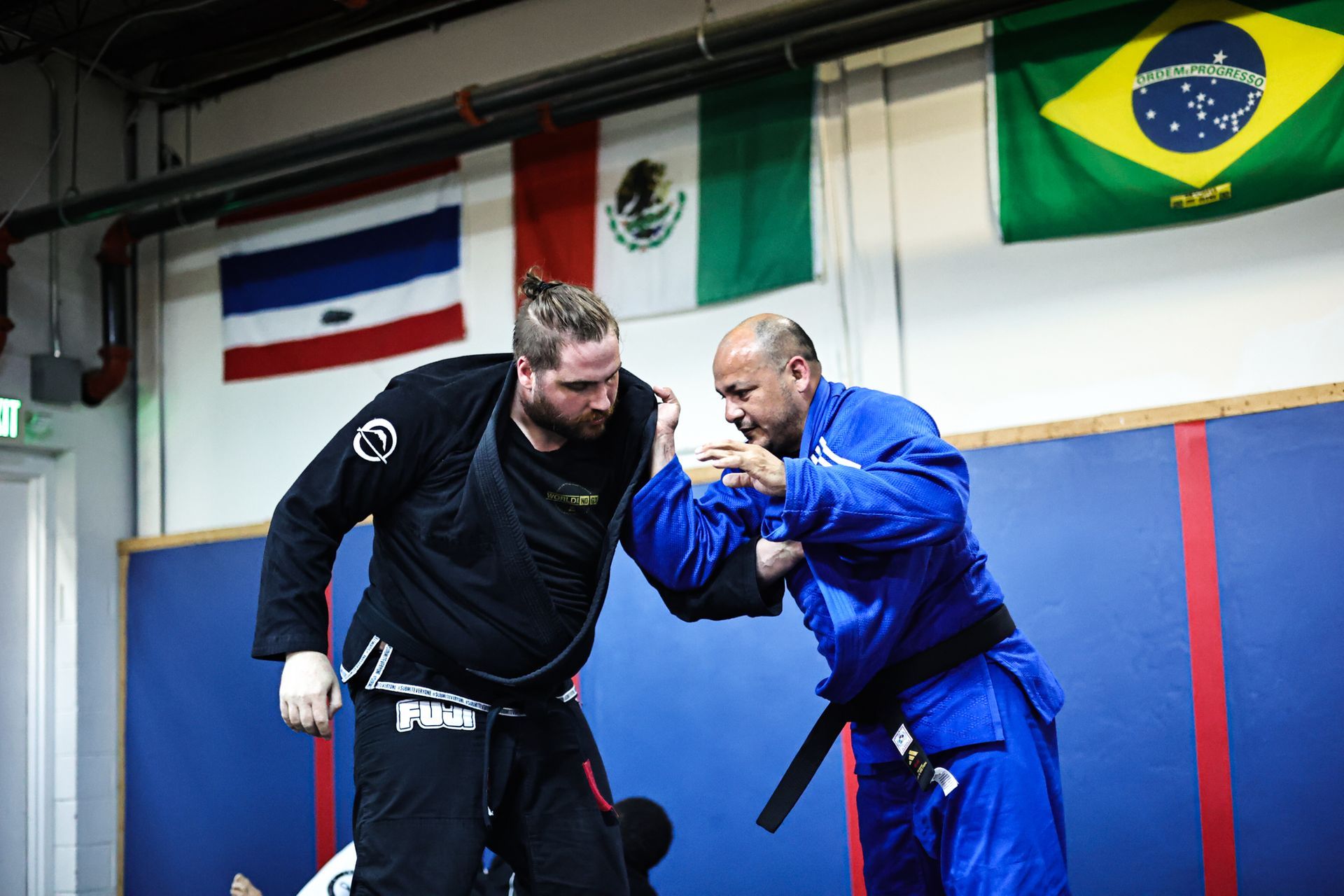
That starts with how we teach. We emphasize fundamentals, safety, and smart pacing. You will drill technique, ask questions, and build skill layers that make sparring feel like learning, not survival. Yes, training is challenging, but it should be the right kind of challenging, the kind that leaves you proud instead of wrecked.
We also respect the fact that adults show up with real lives. Some days you are sharp. Some days your brain is full. Either way, you can train. We would rather you come in, move, breathe, and leave with your shoulders lower than skip because you are not “ready.”
What a first month of Jiu-Jitsu can do for everyday stress
The first month is where many people notice the biggest contrast, even if their technique is still clumsy (which is normal). You will learn basic escapes, simple control positions, and how to keep yourself safe. That alone can change how you carry yourself.
But the stress benefits show up in quieter ways:
• Sleep often improves because your body has a clear physical outlet
• Your mind gets a weekly reset from constant screens and notifications
• You start noticing breathing patterns and tension you used to ignore
• You experience small, frequent wins that rebuild confidence
We also see a practical emotional shift: you get comfortable being uncomfortable. That is a powerful skill in a high-pressure Maryland lifestyle, because discomfort stops feeling like danger.
Why Jiu-Jitsu works especially well for Maryland professionals and first responders
Maryland has plenty of high-responsibility roles packed into a relatively small region. People commute, respond to emergencies, manage teams, and hold a lot of weight for others. Even when you are “off,” your brain might still be scanning.
Training gives you a structured place to discharge adrenaline and practice composure. For veterans and first responders in particular, emerging longitudinal research has shown sustained reductions in PTSD markers with consistent Brazilian Jiu-Jitsu practice. We are careful not to overpromise or replace professional care, but we are comfortable saying this: the combination of physical exertion, problem-solving, and community is a rare and useful mix.
And if your stress is more typical than traumatic, the same skills still help. You learn to steady yourself, breathe, and solve the next problem without spiraling.
The physical side of stress relief: strength, conditioning, and feeling capable again
Stress lives in the body. Tight hips from sitting, stiff neck from driving, and that background fatigue that makes everything feel harder than it should. Jiu-Jitsu addresses this in a way that feels more engaging than typical workouts.
Training builds:
• Cardiovascular conditioning through rounds and movement
• Functional strength through gripping, framing, and posture
• Mobility and body awareness as you learn how to move efficiently
• Endurance and recovery through progressive pacing
You do not have to be in shape to start, but you will get in shape by doing the work. It is one of the few training methods where mental focus and physical fitness improve together, and that combination is a big part of why stress levels drop.
A simple plan for getting the most stress relief from training
We like straightforward plans because adults are busy. If your main goal is lowering stress, you do not need a complicated system. You need repeatable habits.
Here is a practical approach we recommend for most beginners:
1. Train twice per week for the first 8 to 12 weeks to build rhythm and familiarity.
2. Keep your goal small at first: learn one escape and one control position well.
3. Prioritize breathing during drills and sparring, especially when you feel stuck.
4. Track one non-technical win each week, like better sleep or calmer reactions.
5. Add a third day only when your recovery and schedule feel stable.
This approach lines up with how long it typically takes for your body and mind to adapt. Many people report meaningful emotional changes within a few months, especially when training becomes part of a routine rather than a burst of motivation.
What you will learn in our Adult Jiu-Jitsu program (and why it reduces stress)
Stress relief is not only about moving. It is also about clarity. When you know what you are doing, your brain relaxes. Our curriculum emphasizes fundamentals that give you that clarity faster.
In our Adult Jiu-Jitsu in Maryland program, you can expect to work on:
• Positional escapes that reduce panic and build confidence under pressure
• Guard basics that teach you how to create space and slow things down
• Top control concepts that reward patience, balance, and steady progress
• Submissions taught with safety and control, not brute force
• Live training that is scaled to your experience level and goals
If you are searching for Jiu-Jitsu in Maryland because you want a healthier relationship with stress, this kind of structure matters. It turns chaos into a learnable process.
The “secret” isn’t toughness, it’s community and consistency
One of the most underrated parts of stress reduction is being around people who are doing something difficult on purpose. It recalibrates your perspective. Your day might be complicated, but you are not alone in it.
We see friendships form naturally because training requires trust. You drill with someone, you learn each other’s pace, you laugh at the awkward moments, and you get better together. For many adults, that becomes a rare third place, not work and not home, but a consistent community that expects you to show up as you are.
And yes, families are part of this too. Martial arts participation trends show strong family involvement nationally, and we feel that locally as well. When parents train, stress does not just decrease for one person. It can change the tone of a household.
Take the Next Step
If your days feel compressed, noisy, and a little too relentless, Jiu-Jitsu gives you a place to practice steadiness in a real way, not a motivational way. You learn how to breathe through pressure, solve problems with a clear head, and leave class feeling like your body and mind are back on the same team.
We built Infinity Jiu-jitsu and Judo in Timonium for adults who want practical training and a healthier relationship with stress, whether you are brand new or returning after years away. If you are ready to turn daily pressure into something you can manage and even grow from, we would love to have you in.
Continue your Jiu-Jitsu journey beyond this article by joining a class at Infinity Jiu-Jitsu and Judo.