
Real self-defense is less about tough-guy tricks and more about simple, repeatable skills you can actually apply under stress.
If you have ever watched a Jiu-Jitsu class and thought, That looks technical, but I am not athletic enough for that, you are not alone. We hear that concern all the time, especially from adults who have jobs, families, stiff hips, old knee quirks, and real lives that do not leave room for getting smashed every night. The good news is that practical self-defense does not require a giant highlight reel of fancy moves.
We teach Jiu-Jitsu as a skill set built on leverage, timing, and decision-making. That matters because most real-world problems happen at close range, where balance breaks down, space disappears, and strength alone stops being the deciding factor. You want tools that work when your heart rate jumps and your brain gets noisy.
And while Jiu-Jitsu is incredibly effective, we also keep it honest: no martial art covers every scenario by itself. That is why our training emphasizes awareness, smart positioning, and controlled responses that help you create space, escape, and get safe. For most people, that is the real win.
Why Jiu-Jitsu Works When Things Get Close
Jiu-Jitsu has exploded in popularity for a reason. Search interest has risen sharply over the last two decades, and millions of people train worldwide. We see the same trend locally: more adults want practical skills, a healthy challenge, and a training environment where progress is measured in real ability, not bravado.
In self-defense, Jiu-Jitsu shines because it gives you reliable answers in clinch and ground scenarios. If someone grabs you, crowds you, or knocks you down, you need a way to stabilize, protect yourself, and either control or escape. We focus on positions that slow chaos down.
What you learn first is not a submission. It is how to survive: posture, frames, base, and the ability to breathe while you work. That alone changes how you move through the world.
The Self-Defense Mindset We Build First
Before we talk technique, we teach you how to think. In real life, you do not get a warm-up round and a coach yelling tips. You get surprise, adrenaline, and uncertainty. So our approach starts with a simple principle: protect yourself, improve your position, then decide your next step.
That means we practice staying calm in bad spots. It is not always comfortable, but it is incredibly empowering. Over time, you start to recognize patterns: where danger spikes, where you can create space, and when it is smart to disengage.
We also talk through boundaries, awareness, and de-escalation. Self-defense is not just physical. It is also the choices you make before contact ever happens.
Move 1: The Protective Frame and Distance Reset
A frame is one of the most beginner-friendly self-defense tools in Jiu-Jitsu, and it is something you can practice immediately. A frame is simply using your forearms and hands as a strong structure to keep someone from collapsing onto you. Think of it as building a temporary shield that buys you time.
We teach frames from standing clinch, against a wall, and on the ground. The goal is not to shove someone across the room. The goal is to stop forward pressure long enough to move your feet, angle your hips, and reset distance.
In practical terms, frames help you avoid getting pinned, protect your head and neck, and create space for an exit. And yes, it feels almost too simple at first. Then you feel how hard it is to crush someone who frames correctly, and you start to trust it.
Move 2: The Clinch Entry to Body Lock for Control
A lot of real altercations turn into awkward grabbing. Someone reaches for your hoodie, your wrist, your shoulders. When that happens, we want you to have an answer that does not rely on trading punches.
We teach a basic clinch entry into a body lock because it gives you control without needing to be stronger. With correct head position, tight elbows, and good foot placement, you can neutralize wild movement and prevent someone from winding up for big swings.
From there, we work on steering. Self-defense is often about managing direction: turning someone away from you, keeping your balance, and guiding the situation toward an exit. A clean body lock does that. It is also a foundation for safer takedowns that do not require you to dive underneath someone.
Move 3: The Trip Takedown That Keeps You Upright
In self-defense, you generally do not want to launch yourself to the floor unless you have to. That is why we emphasize takedowns that keep you standing, balanced, and able to disengage.
A simple outside trip, done from the body lock, is one of the easiest takedowns to learn and one of the most useful. You off-balance your partner, block the leg, and guide them down while you stay stable. The details matter, but the concept is straightforward: take their base away, not their head off.
We also teach you what not to do: leaning too far, crossing your feet, and falling into top of someone without a plan. Staying upright is the habit we want.
Move 4: The Technical Stand-Up (How You Safely Get Back to Your Feet)
If you train Jiu-Jitsu for self-defense, the technical stand-up is a non-negotiable skill. It is the method of standing up while protecting your head and maintaining distance with your legs. And it is surprisingly useful even outside the gym. You notice it when you stand up off the floor at home and your body automatically chooses a safer pattern.
We drill it because it works when you are tired, when you are startled, and when someone is in front of you. You post a hand behind you, keep your opposite hand up to protect your face, slide your hips back, and stand while keeping your eyes on the threat.
It is not flashy, but it is a lifesaver. If your main goal is to escape, you need a reliable way to get upright without turning your back or exposing your head.
Move 5: Guard Retention Basics (Using Your Legs as a Shield)
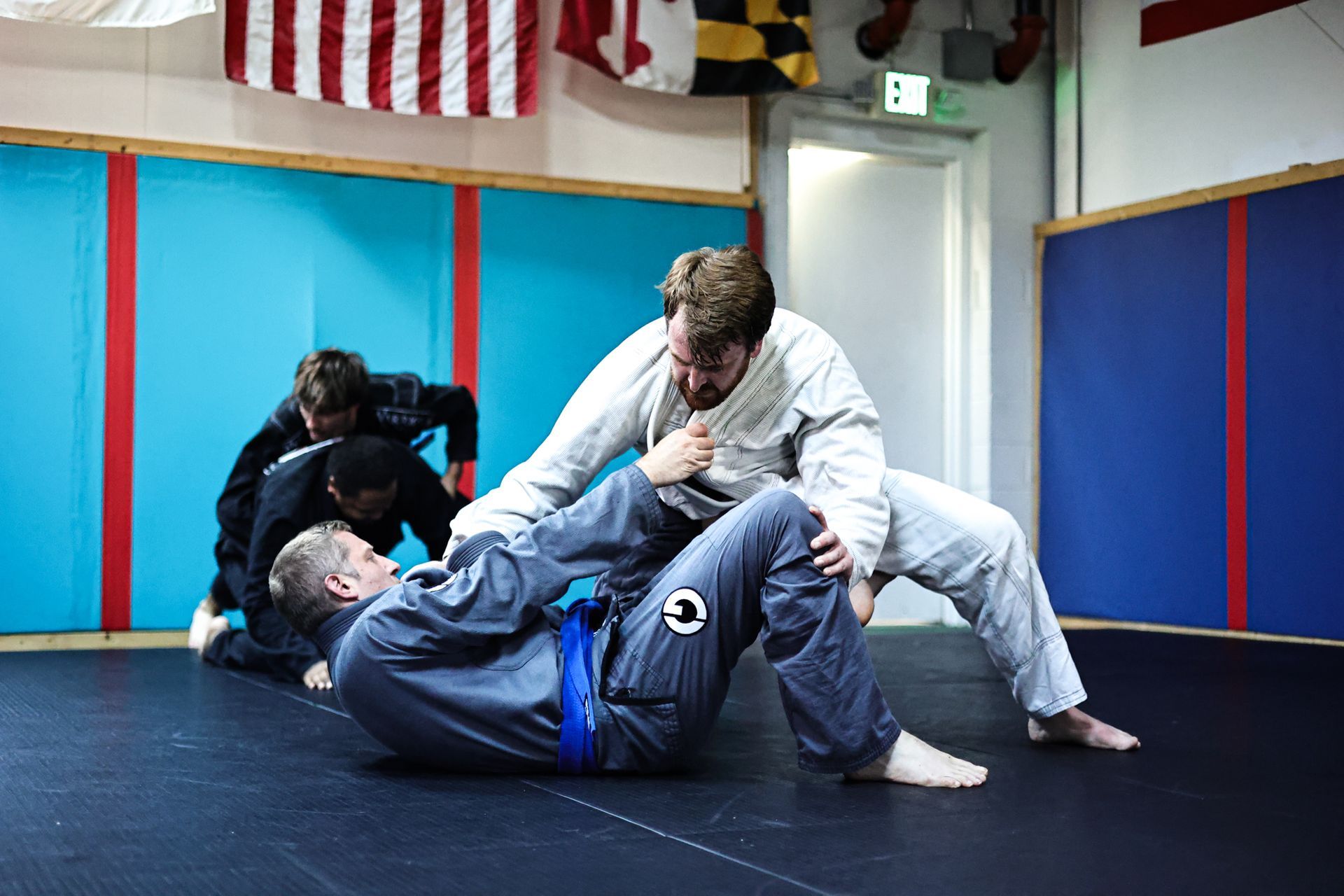
People hear the word guard and assume it means you are losing. In Jiu-Jitsu, guard is a working position. It is how you protect yourself when you are on your back and someone is trying to close distance.
For self-defense, we focus on simple guard retention concepts: keeping your knees between you and the other person, managing distance with your feet, and framing to protect your head. Your legs are strong, and they are built to carry weight. We teach you to use them as a barrier that stops someone from sitting on you.
This is where beginners often have an aha moment. You do not need to bench press someone off you. You need angles, hip movement, and structure. When those pieces click, you feel safer on the ground almost immediately.
Move 6: The Mount Escape You Can Repeat Under Stress
Mount is a worst-case scenario for many people: someone sitting on your torso, hands free, gravity working against you. We treat mount escapes like a core life skill, not an advanced technique.
We teach a simple bridging and elbow escape with emphasis on protecting your face, trapping an arm when possible, and moving your hips, not just your shoulders. Small details make it work: where your feet go, when you bridge, and how you turn onto your side.
The reason mount escapes matter for real-world self-defense is simple. If you can escape mount, you can survive a lot of bad moments long enough to get to safety.
Move 7: The Back Escape and Hand Fighting (Protecting Your Neck)
If someone gets behind you, the biggest immediate danger is often the neck. So we teach two things early: how to hide your neck and how to fight hands. Hand fighting is not glamorous, but it is the first layer of defense against chokes and grabs.
We focus on stripping grips, keeping your chin tucked, and getting your back to the floor or to a safer angle. We also teach you how to move your hips so you are not just peeling fingers while staying stuck.
In sport training, back control is a dominant position. In self-defense training, back defense is a priority because it addresses one of the most common and dangerous ways people get controlled.
Move 8: The Rear Naked Choke as a Last-Resort Stop Button
We treat submissions differently when the conversation is self-defense. Our priority is always escape and safety. Still, it helps to understand a decisive option if you truly cannot disengage.
The rear naked choke is a high-percentage technique in grappling and in professional competition, and it works because it does not rely on size. It relies on correct placement and tight control. We teach it with strong safety standards, careful coaching, and a clear understanding of when it is appropriate.
We also emphasize awareness: if you are in a situation where you cannot safely stay engaged, you do not hang around to prove a point. The goal is to stop the threat long enough to leave.
How We Teach These Moves So You Can Actually Use Them
A move you understand in your head is not the same as a move you can use under pressure. So we teach progressively. You learn the shape of the technique, then you learn timing, then you learn it against increasing resistance.
Here is what that progression usually looks like in our adult program:
1. We teach the position and the why, so you understand what problem the move solves
2. We drill with a cooperative partner to build smooth mechanics and safe habits
3. We add situational rounds where you start in the exact position you are learning
4. We layer in controlled sparring so your skills hold up when things get messy
5. We revisit the same fundamentals often, because repetition is what makes it real
That structure is why beginners improve faster than they expect. You are not just collecting techniques. You are building reflexes.
What Adults in Timonium Usually Want From Training
When people ask about Adult Jiu-Jitsu in Timonium MD, most are not chasing medals. You want practical self-defense, better conditioning, and a way to feel capable in your body again. Some of you want stress relief that is not another screen. Some of you want a challenge that is honest, measurable, and a little addictive in a good way.
Adult Jiu-Jitsu in Maryland also has a specific reality: busy schedules. So we design training to be efficient. You should leave class feeling like you learned something that matters, even if you can only train a couple days a week.
We also keep the room welcoming. You do not need to be in shape to start. Getting in shape is a result of consistent training, not a requirement to walk in the door.
Safety, Confidence, and the Benefits You Notice Outside the Gym
One underrated part of Jiu-Jitsu is what it does for your mindset. Research on grappling athletes suggests that training experience is associated with increased resilience, self-efficacy, and self-control. That matches what we see: as you get more mat time, you get better at staying composed in hard moments.
Physically, you build strong hips, grip strength, core stability, and cardio that feels practical. Mentally, you get comfortable being uncomfortable, which sounds odd until you feel it improve your everyday patience.
We also care about training smart. Studies comparing martial arts injury rates have found Brazilian Jiu-Jitsu can have fewer injuries per exposure than several other popular combat sports. Good coaching, controlled intensity, and a culture of tapping early all matter, and we take that seriously.
Take the Next Step
Building real self-defense skill is not about learning 100 moves. It is about owning a handful of dependable Jiu-Jitsu solutions you can perform when your hands shake a bit and your breathing gets fast. If you can frame, stand up safely, escape pins, and control distance, you are already far ahead of where most people start.
That is exactly what we focus on at Infinity Jiu-jitsu and Judo. If you are looking for Adult Jiu-Jitsu in Maryland with a practical, supportive training environment in Timonium, we would love to help you get started, one repeatable skill at a time.
See firsthand what makes training at Infinity Jiu-Jitsu and Judo exceptional by joining a Jiu-Jitsu class today.