

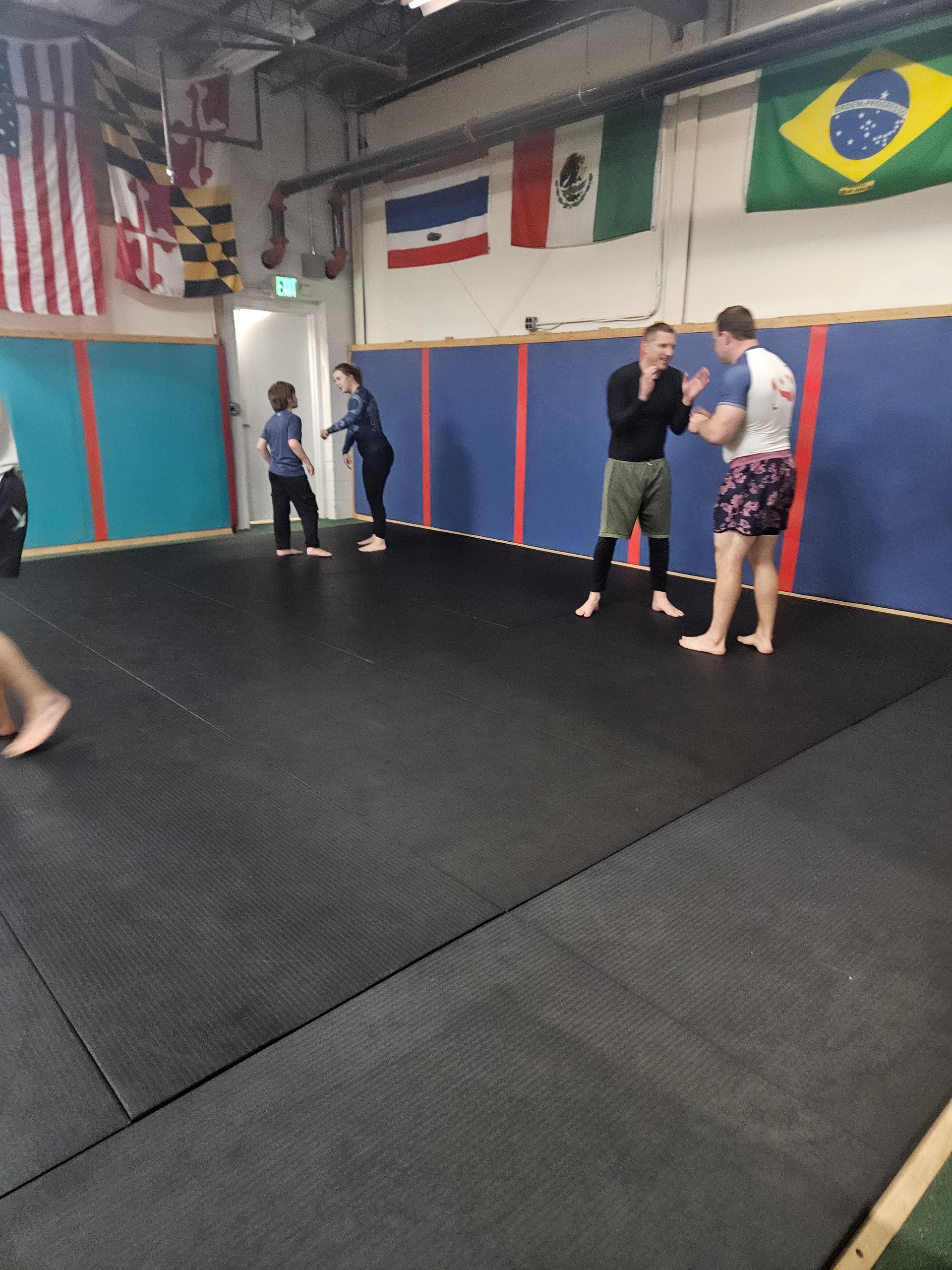
Discipline is not something you lecture into a kid or adult, it is something you practice until it becomes normal.
In Timonium, life moves fast: school demands, busy commutes, packed calendars, and a lot of screen time competing for attention. When families ask us how to build discipline, we usually start with a simple truth: discipline is a skill, not a personality trait. And skills grow best when you train them consistently.
Jiu-Jitsu is one of the clearest ways we know to build that skill because it gives you structure without being rigid, challenge without being unsafe, and feedback that is immediate but fair. You do not have to guess whether you are improving. You feel it in your timing, your posture, your focus, and your ability to stay calm when something is hard.
Research lines up with what we see on the mats. Studies on Brazilian Jiu-Jitsu show that advanced practitioners report higher mental strength, self-control, grit, and self-efficacy than beginners, and that life skills like discipline and respect transfer into daily routines for the vast majority of students. That is exactly why we built our training path to be progressive, measurable, and steady, especially for families looking for kids martial arts in Timonium MD.
Why Jiu-Jitsu Creates Discipline (When Training Is Structured)
Discipline grows when three things show up together: clear expectations, repetition, and accountability. Jiu-Jitsu naturally includes all three. The class has a beginning, a middle, and an end. The techniques have names, details, and rules. And your training partner gives you real-time feedback, because if you drift mentally, your position drifts too.
We also like that Jiu-Jitsu rewards patience. You cannot brute-force most problems for long, and that matters for kids and adults alike. Technique over strength is not just a slogan. It is a daily lesson in choosing control instead of panic, and practice instead of shortcuts.
For many families in kids martial arts in Maryland, the appeal is practical: you want something that helps with confidence, posture, coordination, and focus, without turning into chaos. Jiu-Jitsu does that when classes stay consistent and the culture stays respectful.
Step 1: You Build Routine Before You Build Skills
The first discipline win is simple: showing up. We keep class structure predictable so your brain can settle in quickly. When students know what to expect, it becomes easier to participate fully, even after a long day of school or work.
A typical class rhythm includes warm-ups, skill instruction, drilling, and controlled sparring or positional work, followed by a clear wrap-up. That routine might sound small, but it is exactly how habits form. Over time, discipline stops feeling like effort and starts feeling like what you do on training days.
If you are a parent, you will notice the routine effect outside the gym too: kids get better at being on time, keeping track of their gear, and transitioning from one activity to the next without the usual arguments. That is not magic. That is practice.
Step 2: Mat Etiquette Teaches Respect and Self-Control
Jiu-Jitsu discipline is not only about grit. It is also about manners, awareness, and how you treat people when you are tired. On the mats, we reinforce simple expectations: listen when someone is explaining a technique, be a safe partner, and respect the space and the team.
This is where the Judo influence matters as well. Bowing, partner awareness, and controlled movement are not old-fashioned traditions for decoration. They teach humility and restraint, which is the real backbone of discipline. Kids learn quickly that being wild is not the same as being brave.
We also see something else happen here: students realize that self-control is a choice. When you are excited, frustrated, or nervous, you still have to follow instructions, keep your hands safe, and breathe. That translates directly to school, sibling conflict, and sports.
Step 3: Drilling Builds Perseverance the Boring Way (Which Is the Real Way)
Drilling is where discipline gets real. Nobody looks glamorous repeating the same movement again and again. But that repetition is the difference between knowing a technique and being able to use it under pressure.
We teach students to work in rounds, focus on one detail at a time, and improve through small corrections. That approach is especially effective for kids because it creates a clear connection between effort and results. If you show up and drill, you improve. If you skip steps, you feel it right away.
This is also one reason Jiu-Jitsu outperforms many activities for individual development. You cannot hide behind a scoreboard or a teammate. Your progress is yours, and it is earned one rep at a time.
Step 4: Positional Sparring Trains Emotional Control Under Pressure
If you want to see discipline in action, watch a student in a tough position choosing to breathe, frame, and escape instead of panicking. That moment is the whole point.
We use controlled sparring formats to teach composure. Instead of tossing beginners into chaos, we set boundaries: start from a specific position, work toward a simple goal, reset, and repeat. This gives students enough stress to grow, without overwhelming them.
Here is what that teaches, in plain language:
• You can feel uncomfortable and still think clearly
• You can lose a round and still come back focused
• You can handle intensity without losing your temper
• You can be competitive without being disrespectful
• You can stay calm even when you are not “winning” yet
Those are life skills. And research supports that the mental benefits of martial arts training can be significant, with many participants reporting improved resilience, focus, and reduced stress when training consistently.
Step 5: Belt Progression Turns Discipline Into Goal-Setting
Belt systems work when they are honest. In Jiu-Jitsu, you do not get promoted because you showed up once, or because you wanted it badly. You earn progress through consistency, attention to detail, and the ability to apply skills safely.
That process trains delayed gratification, which is one of the most important discipline muscles for kids today. When everything else is instant, Jiu-Jitsu is a place where progress takes time and that is normal.
We also like how belt goals can be broken into smaller wins. Instead of one huge target, students focus on:
1. Attendance consistency over weeks and months
2. Mastery of specific techniques and escapes
3. Better decision-making during sparring
4. Safer, more controlled movement with partners
5. A stronger mindset when training feels hard
When you tie effort to clear standards like this, discipline becomes practical instead of abstract.
Step 6: You Learn to “Reset” After Mistakes (Without Spiraling)
Mistakes happen constantly in Jiu-Jitsu. You forget a grip, you turn the wrong way, you get swept, you tap. The disciplined response is not to quit or get angry. It is to reset.
We coach students to treat mistakes as information. What happened right before the sweep? Where did your elbow drift? Did you hold your breath? That process builds self-awareness, and self-awareness is what makes discipline sustainable.
For kids, this can be a quiet breakthrough. A child who melts down when something is hard starts to realize, slowly, that frustration is not an emergency. It is just a signal to breathe and try again. You cannot fake that lesson. You have to live it.
Step 7: Discipline Transfers Off the Mats (If You Name It)
One of the most useful things we do is help students connect training behaviors to real life. Research suggests that around 96.9 percent of participants report life skill transference from training, and we are intentional about making that transfer easier.
After class, we encourage quick reflection. Nothing dramatic. Just a couple of questions:
• What was one thing you did well today
• What is one detail you want to improve next time
• Where could you use that same focus at home or at school
Parents often tell us this simple routine improves homework habits and reduces morning chaos. Again, it is not because Jiu-Jitsu is mystical. It is because you practiced discipline in a real environment, then named the lesson.
What This Looks Like for Kids in Timonium
Families searching for kids martial arts in Timonium MD are usually not looking for more pressure. You are looking for something that helps your child mature, listen, and feel capable. We design kids classes to be structured, positive, and safe, with clear boundaries and plenty of movement.
Kids typically gain:
• Better posture and coordination through controlled movement and balance
• Confidence that comes from competence, not just cheering
• Social skills like taking turns, partnering respectfully, and following group rules
• Problem-solving skills, because every position is a puzzle
• A calmer response to stress, because training normalizes challenge
And yes, there is also the practical self-defense element. Technique-based grappling builds body awareness and control, and studies in applied settings show trained individuals can reduce injuries in force encounters, which reinforces the idea that training helps you act with restraint and precision.
How Long Until You Notice More Discipline
You will often notice early changes within a few months if training is consistent, especially in routines like punctuality, focus, and listening. Bigger changes like emotional control under pressure and long-term grit take longer, and that is fine. Jiu-Jitsu is not a quick-fix activity. It is a long-game practice.
The key is consistency. Training twice a week is a strong baseline for most students, and many families find that a steady schedule builds momentum. When you treat training like brushing your teeth, discipline becomes part of the week instead of a special event.
Take the Next Step
If you want a clear, step-by-step path to discipline that your family can actually stick with, we built our programs to make that practical in Timonium. The structure of Jiu-Jitsu, combined with a respectful culture and progressive coaching, gives you a place to practice focus, patience, and resilience in a way that shows up at home and at school.
At Infinity Jiu-jitsu and Judo, we keep training approachable for beginners while still holding real standards, because discipline grows best when the expectations are clear and the environment feels supportive.
Develop strong fundamentals and elevate your training by joining a Jiu-Jitsu class at Infinity Jiu-Jitsu and Judo.