
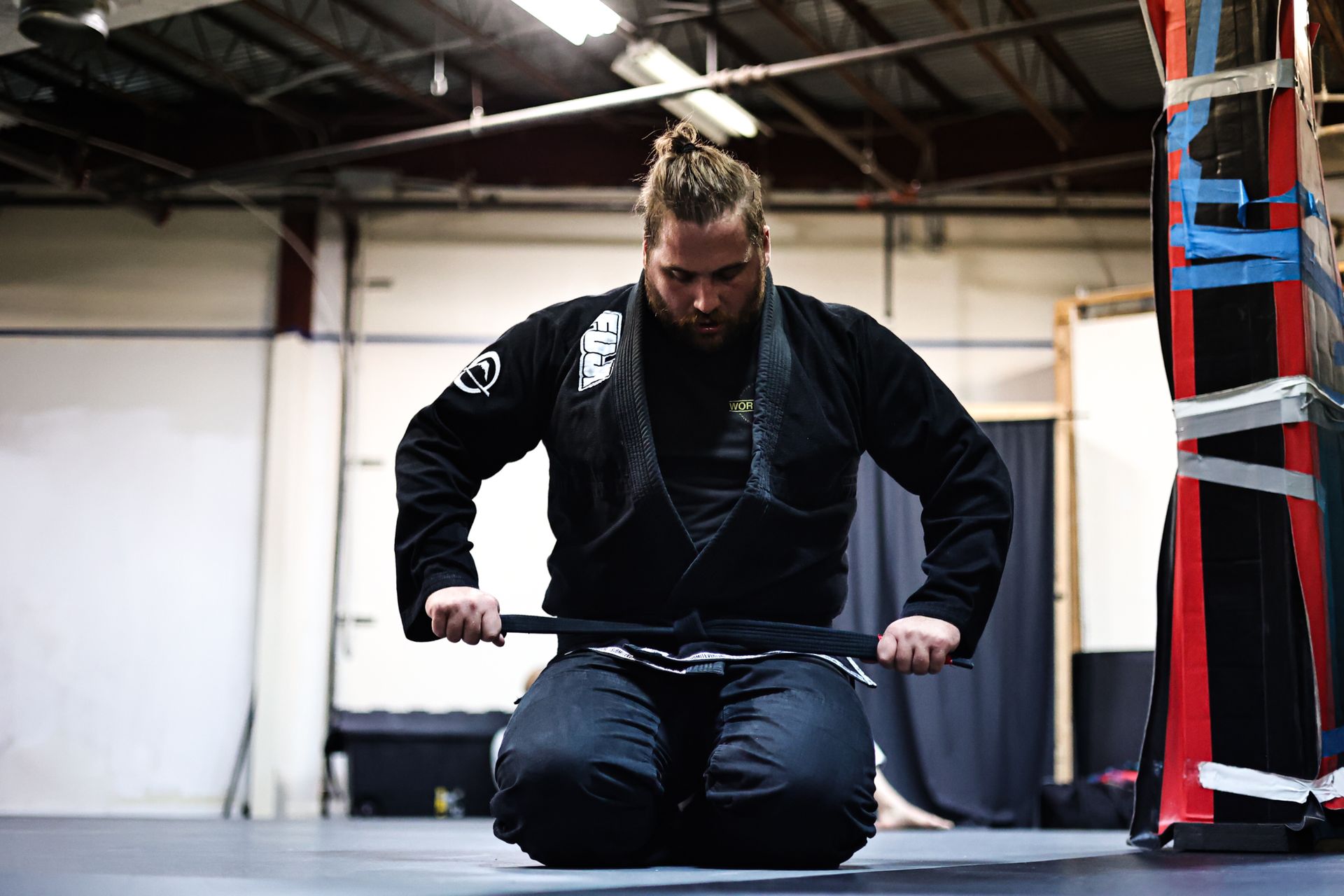
Jiu-Jitsu is the rare workout that trains your body hard while teaching your brain to stay calm, curious, and sharply present.
If you have ever wished you could feel more locked in during your day and more capable in your body, Jiu-Jitsu is a practical way to build both at the same time. On the mat, you cannot multitask, scroll, or mentally drift. You are either paying attention or you are getting gently reminded to pay attention, which is honestly part of the appeal.
In our Timonium classes, we see the same pattern again and again: students come in looking for fitness, self-defense, or a new challenge, and they stay because the mental focus carries over. Training gives you a place to think clearly under pressure, solve problems with your hands and your head, and finish class feeling physically worked but mentally lighter.
This article breaks down how Jiu-Jitsu improves focus and decision-making, why it builds real-world fitness you can feel, and how we make the process approachable for beginners, kids, and adults who want long-term progress.
Why Jiu-Jitsu Demands Real Focus (and Builds It Fast)
Jiu-Jitsu is not a “just push through it” kind of workout. It is a thinking art. Every position is a puzzle, and every puzzle changes when your partner moves. That constant feedback loop is one reason the training sharpens attention so quickly.
When you practice techniques, you learn to notice small details: where your weight is, what your hips are doing, whether your grip is helping or just exhausting your forearms. In live training, you learn to prioritize: fix posture first, then frames, then escape, then improve position. That sequence is focus in action, not the abstract kind.
Over time, that skill transfers off the mat. Many students tell us they feel less scattered at work, more patient in traffic, and more able to stay present in conversations. It is not magic. It is repetition. You spend hours practicing calm decision-making in a controlled setting, and your brain starts treating that as normal.
Flow state: the “quiet mind” effect you can actually practice
People sometimes describe Jiu-Jitsu as moving meditation, and we get why. When you roll, your mind often gets quieter because it has to. You cannot plan next week’s schedule while someone is passing your guard. You have one job: solve what is happening right now.
That intense present-moment demand is a gateway to flow state, the feeling of being fully immersed and effective. Flow is tied to improved performance and learning, and it is one reason many adults come back to training even when life gets busy. You leave class tired, but not mentally frayed. The noise turns down.
Problem-solving under pressure builds better decisions
In Jiu-Jitsu, you are constantly running mini experiments:
- If you turn this way, what happens
- If you frame here, does it buy you space
- If you slow down your breathing, do you stop panicking and see the opening
That habit of testing, adjusting, and staying composed is what good decision-making looks like in everyday life too. You get used to the idea that pressure is not a signal to freeze. It is a signal to return to fundamentals.
The Neuroscience Side: Why Training Changes Your Mindset
You do not need to be a neuroscience expert to feel the mental changes, but it helps to understand why they happen. Skill-based training promotes neuroplasticity, your brain’s ability to rewire through practice. Every time you learn a new guard pass, escape, or throw setup, you are building new movement maps and improving coordination between body and brain.
Jiu-Jitsu also tends to support emotional regulation. You face discomfort in a safe environment and practice staying functional inside it. That is a powerful skill for adults with demanding jobs and for kids who are still learning how to handle frustration without melting down.
Many students also notice a mood lift after training. Hard physical work plus social connection plus small wins (even tiny ones) is a reliable recipe for stress relief. You finish class feeling more grounded, and that matters in a world that keeps trying to pull your attention in ten directions.
Physical Fitness: Why Jiu-Jitsu Works When Other Workouts Get Old
A lot of fitness programs build one quality at a time. Jiu-Jitsu trains several at once, mostly because you cannot avoid it. Rolling is cardio. Holding positions builds strength and endurance. Shrimping, bridging, and moving your hips build mobility. Trying to stay balanced while someone off-balances you improves coordination in a way machines never quite replicate.
You will feel it in daily life. Stairs get easier. Carrying groceries feels lighter. Getting up off the floor becomes less of a production. For many adults, that “usable” strength is the main win.
What changes first for most beginners
The first few weeks are usually when students notice:
- Improved cardiovascular endurance, because rounds force steady output
- Better core and grip endurance, because posture and control demand it
- Increased mobility in hips and shoulders, because positions ask for it
- Weight loss or body recomposition, because training burns serious energy
It is also common to feel sore in muscles you did not realize you had. That eases as your movement gets more efficient. Technique starts replacing tension, which is one of the best signs you are learning.
Conditioning without the boredom factor
One underrated benefit is that Jiu-Jitsu rarely feels repetitive. Even when you drill the same technique, your partner’s reactions make it new. And during sparring, every round is a different conversation. That variety makes it easier to stay consistent, and consistency is the real engine behind fitness changes.
How We Structure Training to Build Focus and Fitness Safely
Good training is not just “go hard.” Our classes are structured to help you improve without feeling lost or overwhelmed. We teach technique in a progressive way, then we give you a safe way to test it, and we keep the room focused on learning.
A typical class flow includes instruction, drilling, and supervised live rounds. You learn what to do, you practice it with intention, and then you apply it with a partner who is also trying to learn. That balance is where the mental focus and physical fitness improvements stack up quickly.
Beginner-friendly learning: clarity beats chaos
Beginners need clear goals. If you are new, we do not expect you to memorize a thousand moves. We coach you toward a smaller set of fundamentals that show up everywhere: posture, base, breathing, frames, hip movement, and positional awareness.
That structure helps your mind settle. When you know what you are looking for, your focus stops scattering. You begin to notice patterns, and that is when Jiu-Jitsu starts feeling less like chaos and more like problem-solving.
The value of controlled sparring
Live training is where the fitness and focus really sharpen, but it has to be done responsibly. Controlled sparring teaches you timing, composure, and realistic effort. You learn when to push and when to conserve energy. You learn to stay technical instead of just tense. Those lessons protect your body and build confidence at the same time.
Jiu-Jitsu for Kids in Timonium: Focus, Confidence, and Better Movement
Parents searching for kids martial arts in Timonium MD often want the same things: less screen-time drift, more discipline, better listening, and a healthier outlet for energy. We build kids classes around those outcomes, using age-appropriate structure and coaching that keeps training fun while still being purposeful.
Jiu-Jitsu gives kids a clear framework: pay attention, follow steps, work with a partner, and keep trying even when something is hard. That last part matters. The mat teaches persistence in a way lectures rarely do.
Our kids program also supports coordination and body awareness. Kids learn how to fall safely, move their hips, balance their weight, and stay controlled. Those are athletic skills that help in other sports and in everyday play.
What parents typically notice at home
While every child is different, we often hear parents mention:
- Better ability to focus on instructions and finish tasks
- More confidence in social settings without acting aggressive
- Improved emotional control when frustrated
- A healthier relationship with physical activity
For families looking broadly at kids martial arts in Maryland, the real value is that the lessons are not just physical. Kids are practicing attention, patience, and respectful teamwork every class.
Adults, Over 40, and Busy Professionals: Why This Training Fits Real Life
A common misconception is that you need to be “in shape” before starting Jiu-Jitsu. In reality, training is how many people get in shape. We scale intensity, pair students thoughtfully, and keep the focus on sustainable progress.
Adults over 40 often care about longevity: joints, mobility, and smart conditioning. Jiu-Jitsu can be a great fit because it emphasizes leverage and technique. You learn to rely less on speed and strength and more on timing and position, which is exactly how people continue training for years.
Busy professionals also appreciate that training forces a mental reset. You walk in carrying the day. You warm up, drill, roll, and suddenly your brain has had a break from constant input. Many students describe it as sharpening: you leave clearer than you arrived.
Practical Tips to Get Results Faster (Without Overtraining)
You do not need to train every day to benefit, but you do need consistency. If your goal is better focus and fitness, show up on a predictable rhythm and protect recovery.
Here is a simple approach we recommend for most new students:
1. Train 2 to 3 times per week for the first month to build habits and baseline conditioning
2. Keep a short notebook note after class with one concept you learned and one thing to repeat
3. Prioritize breathing during drilling and sparring to stay calm and avoid gassing out
4. Add light mobility work on off days, especially hips, ankles, and thoracic spine
5. Increase frequency to 3 to 5 sessions weekly only when you feel recovered and excited to train
This is not about grinding. It is about building a practice you can maintain, because long-term consistency is where the biggest physical and mental changes happen.
What to Expect in Your First Few Weeks
The early phase is a mix of excitement and information overload, and that is normal. You will learn positions, terminology, and etiquette. You will also discover quickly that Jiu-Jitsu is humbling in a healthy way. Everyone starts somewhere, and progress is measured in small wins.
In week one, your main job is to show up, stay safe, and learn the rhythm of class. By weeks two and three, you will start recognizing common situations like being in someone’s guard or escaping side control. Somewhere around week four, many students notice they are less tense and more observant, which is when focus starts becoming a skill you can feel.
Take the Next Step
The best way to understand Jiu-Jitsu is to feel it in a well-coached room where learning is the priority. At Infinity Jiu-jitsu and Judo, we build training around real skill development that improves mental focus and physical fitness without turning every session into a grind.
If you are looking for a practice that challenges your brain, strengthens your body, and gives you a clear path forward, we would love to help you start. Infinity Jiu-jitsu and Judo is here in Timonium with a schedule designed for adults, kids, and families who want consistent progress.
Build real grappling skills and refine your technique by joining a Jiu-Jitsu program at Infinity Jiu-Jitsu and Judo.