
Jiu-Jitsu doesn’t just teach kids how to move, it teaches them how to think under pressure.
Parents in Timonium often ask us a practical question: what activity builds confidence without feeding ego, improves fitness without burning kids out, and teaches discipline without feeling like a lecture? Jiu-Jitsu checks those boxes in a way that still surprises people, even after they’ve watched a few classes.
We see it every week on the mats. A student walks in a little unsure, maybe fidgety, maybe shy, and gradually starts standing taller, listening more closely, and handling small setbacks without melting down. That shift isn’t magic, it’s the result of a training environment where effort matters, mistakes are expected, and progress is measured one step at a time.
This matters locally because youth schedules are packed. Between school, screens, and sports, it’s easy for stress and anxiety to creep in early. Our job is to give your child something solid: a place to work hard, feel safe, and learn skills that spill into the rest of life.
Why Jiu-Jitsu “sticks” for kids who don’t love traditional sports
Some kids thrive in big-team sports. Others feel lost in the noise, or they struggle when the game moves too fast and they can’t touch the ball. Jiu-Jitsu is different because every class has a clear structure and everyone gets repetitions. Your child learns a skill, practices it with a partner, and gets immediate feedback in a controlled setting.
Because the sport is based on leverage and positioning, smaller students can succeed without needing to be the fastest or strongest. That becomes a quiet confidence builder, especially for kids who have spent a lot of time feeling “behind.” And when kids realize that technique can solve problems, that mindset often transfers to schoolwork, friendships, and day-to-day decision-making.
Confidence that’s earned, not performed
Confidence is one of the first changes parents notice, and research backs it up. A 2024 survey reported confidence improvements in 96.4 percent of youth participants and life skills transfer in 96.4 percent as well. Those numbers feel big, but on the mats the change can look small: a student raises their hand to ask a question, makes eye contact, or volunteers to demonstrate.
In our program, confidence is earned through doing hard things in manageable doses. Kids learn to problem-solve while tired, stay calm while someone is trying to control them, and keep going after a mistake. They don’t need to “win” to improve. They just need to show up and practice.
We also talk about what real confidence is: being respectful, being prepared, and being able to say “I can handle this” without needing to prove it to anyone.
Focus, behavior, and the surprising calm that shows up at home
If you’ve got a child with extra energy, you already know that “just sit still” rarely works. What tends to work better is giving that energy a job. Jiu-Jitsu offers structured movement with clear rules, which is exactly what many kids need to regulate themselves.
The same 2024 survey reported reduced anxiety in 87.5 percent of youth participants, mood enhancement in 92.8 percent, and concentration improvements in 78.6 percent. We see that in how students settle into class: they learn when to be explosive and when to be still, when to listen and when to act.
Clinical findings in youth combat sports are also encouraging. Studies have shown Brazilian Jiu-Jitsu can reduce ADHD symptoms and aggression in children, and a 12-week training period has been linked with decreases in emotional symptoms, hyperactivity or inattention, and externalizing problems. We never claim training is a replacement for professional care, but we do see it complement support systems well because it provides routine, coaching, and a constructive outlet.
Physical development that looks like real-world athleticism
Youth fitness isn’t only about running laps. We care about balance, coordination, posture, and body awareness, because those are the foundations that keep kids healthy as they grow. Jiu-Jitsu builds functional strength through bodyweight movement, controlled pressure, and constant adjustments. It’s sneaky strength, the kind that shows up when your child carries groceries without struggling or moves confidently on a slippery field.
Our classes include movements that improve:
- Core stability and balance through controlled transitions and holds
- Coordination through stepping patterns, grips, and timing-based drills
- Flexibility and joint awareness through safe ranges of motion
- Cardiovascular fitness through short bursts of effort and recovery
- Injury-resilient movement habits like bracing, posting, and landing safely
Because we progress skills gradually, students build these attributes without being thrown into chaos. Safety and smart development come first.
Social skills and belonging in a space with clear expectations
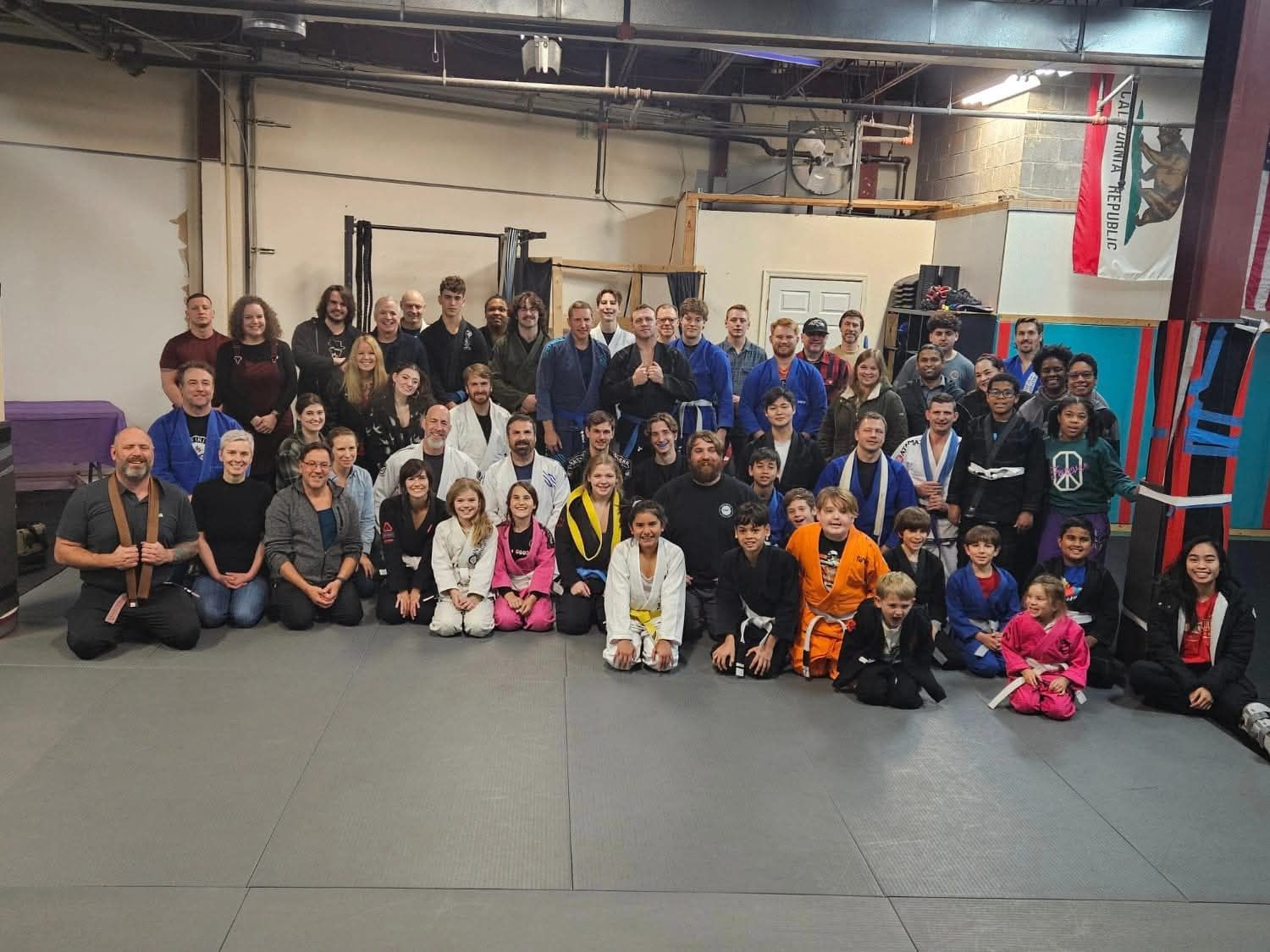
One hidden benefit parents don’t always anticipate is how quickly kids connect. Jiu-Jitsu is a partner-based activity, and that means students practice cooperation constantly. They learn to take turns, communicate, and respect boundaries. If your child is shy, we help them ease in. If your child is loud, we help them channel it. Either way, the room has structure.
Over time, students start learning leadership in a natural way. The more experienced kids often help newer students remember steps or tie a belt properly. That sense of responsibility matters, especially during the middle-school and early-teen years when confidence can wobble.
Resilience and grit: learning to “lose” safely
One of the healthiest things Jiu-Jitsu gives kids is a safe relationship with failure. In training, mistakes happen constantly, and that’s normal. Your child tries a technique, it doesn’t work, and we adjust. Nobody gets benched. Nobody gets mocked. We reset and go again.
That process builds resilience because it teaches a simple pattern:
1. Stay calm
2. Identify what happened
3. Try a small correction
4. Repeat until it improves
This is also why Jiu-Jitsu tends to build commitment. The same 2024 survey showed commitment improvements in 92.8 percent of youth participants and mental flexibility in 92.9 percent. When kids learn that progress is built through reps, they stop expecting instant results everywhere else.
Bullying prevention: skills plus presence
Nationally, about 20 percent of students ages 12 to 18 report being bullied. We approach bullying prevention with nuance. Our goal is not to create “fighters.” Our goal is to develop students who carry themselves with enough confidence that they’re less likely to be targeted, and who also have practical options if a situation becomes physical.
In our youth classes, we emphasize:
- Awareness and posture: how to look confident without looking aggressive
- Boundary setting: using your voice early and clearly
- De-escalation: when to walk away and when to get help
- Control-based self-defense: using grips and positioning rather than striking
- Responsibility: using skills only when necessary and with appropriate judgment
Parents often tell us the biggest change is not a technique, it’s the way their child walks into school on Monday.
Teens in Timonium: independence, pressure, and a place to reset
Teens deal with a different set of challenges: academic pressure, social pressure, identity pressure. Jiu-Jitsu gives them something real in the middle of all that, a place where effort is visible and progress is earned.
For teens who feel stressed or stuck, training can become a reset button. They learn to manage adrenaline, breathe through uncomfortable moments, and keep thinking when things get intense. Research on at-risk youth in grappling and judo-style training also points toward reduced violent tendencies and improved conduct, which aligns with what we aim for: discipline that shows up in everyday choices.
We also keep teen training grounded. Respect is non-negotiable. Nobody gets to “act tough” in a room where technique and control are the standard.
Family training and the bridge to adult classes
A lot of our Timonium families end up training together, and that’s not unusual. Research notes that 87 percent of families with children participate in Brazilian Jiu-Jitsu, highlighting the family-bonding side of the sport. We love seeing that in real life because it changes how fitness fits into a household.
This is also where our adult program matters. When parents train, kids notice. When kids train, parents often get curious. If you’ve been looking for Adult Jiu-Jitsu in Maryland, our schedule makes it realistic to build a routine that doesn’t fight your whole week. And if you specifically want Adult Jiu-Jitsu in Timonium MD, training close to home helps consistency, which is where results actually come from.
Adults get many of the same benefits: stress management, improved fitness, sharper focus, and a community that keeps you accountable in a good way. The difference is you’re modeling the habit in real time, and that’s powerful.
What a first youth class usually feels like
Most new students are nervous for about five minutes. Then they start moving and the nerves fade. We keep introductions simple and structured, because comfort matters early.
A typical first experience includes:
- A quick orientation on mat rules and safety
- Warmups that feel like movement games but build real coordination
- Technique practice with a partner and close coaching
- Drills that help students succeed quickly without overwhelming them
- A short wrap-up where we reinforce progress and expectations
You don’t need your child to be “tough” to start Jiu-Jitsu. You just need them to be willing to try.
Take the Next Step
If you want an activity that strengthens your child from the inside out, Jiu-Jitsu is hard to beat. It builds confidence without ego, focus without harshness, and resilience in a way kids can actually feel, especially once training becomes part of the weekly rhythm.
When you’re ready, we’d love to welcome you to Infinity Jiu-jitsu and Judo in Timonium, MD. Our approach at Infinity Jiu-jitsu and Judo is simple: structured coaching, a supportive room, and a clear path for your child and your whole family to grow.
Ready to train? Join a Jiu-Jitsu class at Infinity Jiu-Jitsu and Judo today.